


Given the monstrous movement of late, I’m sharing today’s full, unlocked Opening Look note.
Key Points
The epic March price action continued on Monday, highlighted by one of the largest intraday reversals we’ve seen in quite some time. Much of the move was tied to crude oil, which experienced one of the biggest downside reversals in its history. That sharp shift created ripple effects across markets, particularly within the S&P 500, which we’ll review in more detail today.
Last Five Trading Days

Daily Price Action
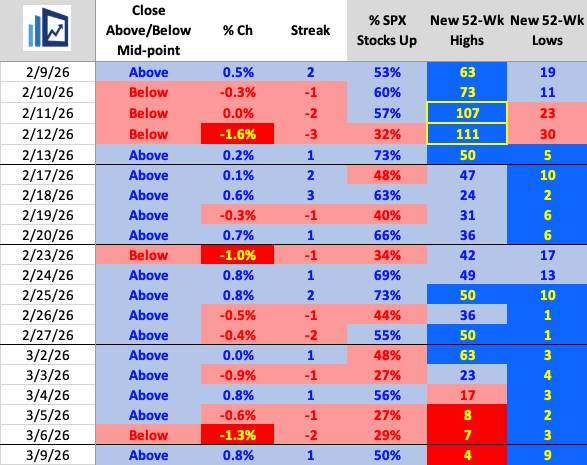
What looked like a certain big decline on Sunday evening turned into one of the strongest advances we’ve seen in a month, with the S&P 500 rallying over 2% intraday before closing with an 80 basis-point gain. That swing pushed the percentage of advancing stocks from below 10% near the open to just over 50% by the close.
Sectors – Tech leads the charge
The day started with energy leading and technology lagging, but by the close the script had flipped. Tech finished as the clear leader, both on the market-cap weighted and equal-weight ETFs. From a breadth perspective, healthcare stood out the most, with nearly 80% of its stocks advancing on the day.

Breadth
The Nasdaq 100 did the best overall, with nearly two-thirds of its components advancing on the day.

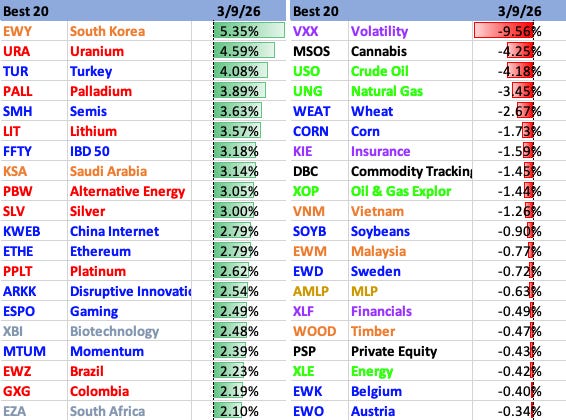
Best and Worst 20 ETFs – Risk Off to Risk On

Bearish Pattern back on hold
So far, the bearish pattern has only been officially active for one trading session, which was last Friday. After yesterday’s massive comeback, the S&P is now back inside the same trading range, and thus above the breakdown zone for the moment. This remains tentative, of course.
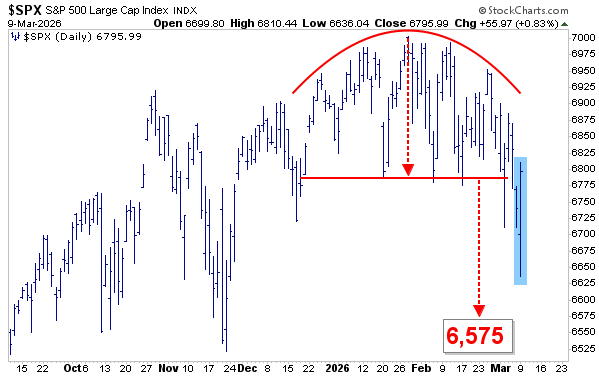
Back in the Box
Naturally, this also means the index slung its way back into the trading box we’ve been tracking. The potential breakdown from that range is therefore on pause for now, as well.

GoNoGo – Remains in NoGo Mode
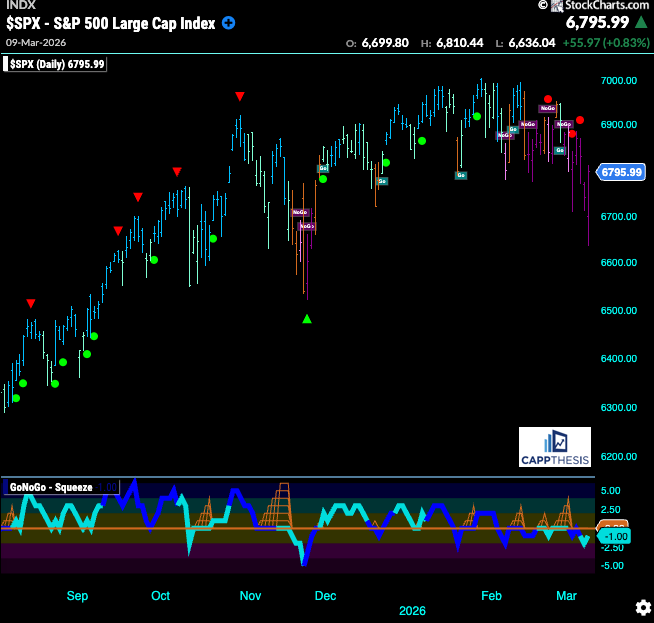
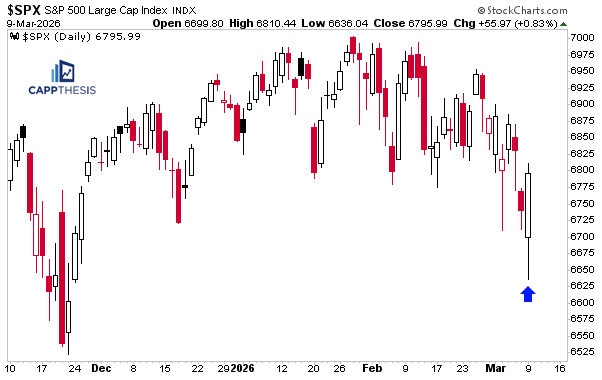
Huge Bullish Engulfing Pattern
From a candlestick perspective, the outside positive day resulted in a bullish engulfing pattern. As we know, this is only the first stage of a reversal, with upside follow-through still needed to fully capitalize the sharp comeback now.
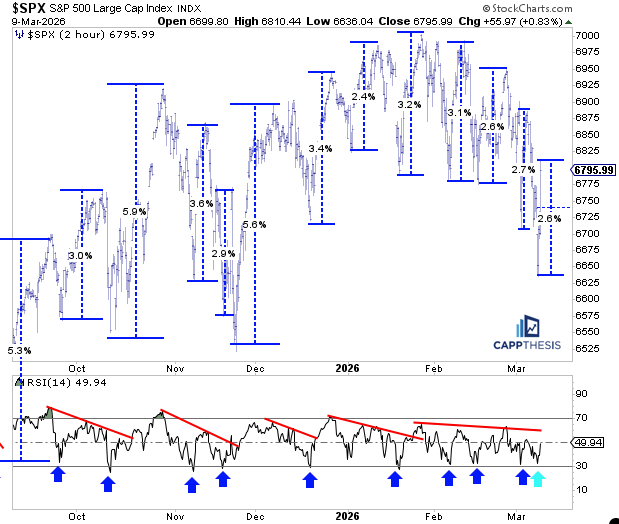
Short-term oversold still encouraging buyers
Looking at the two-hour chart, near the lows yesterday the 14-period RSI grazed the 30 zone, which—coincidence or not—is when the buying spree really took hold and lasted for the rest of the session. By the close, the S&P 500 had gained about 2.6% intraday.
That move now falls right in line with the intermittent rallies we’ve seen since the start of 2026, most of which have ranged between 2.5% and 3.2%.
Naturally, the next step is to do something better with this effort, given that the last few rallies failed to push the RSI back into the mid-60s, let alone overbought territory. As we know, the last time this indicator reached overbought was at the end of 2025.
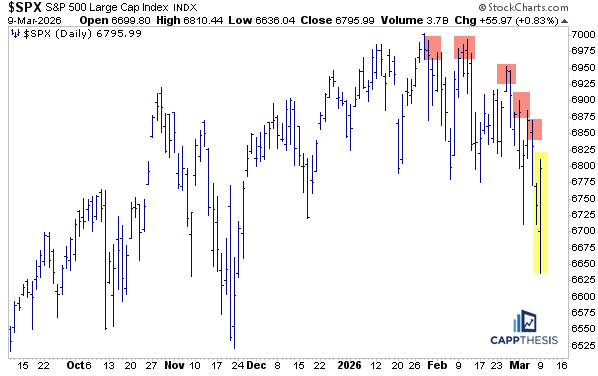
Lower highs still in play
There’s no doubt it was a monster reversal, but the next test is whether the index can break this series of lower highs.
Yesterday’s face-ripping reversal was the largest we’ve seen recently. But taking a step back and looking at the last five to six weeks, the broader pattern hasn’t really changed. Buyers have stepped in at lower levels, but sellers have also appeared sooner, leading to a pattern of lower highs and lower lows.
Quite simply, that dynamic needs to change for momentum to shift from negative back to positive.
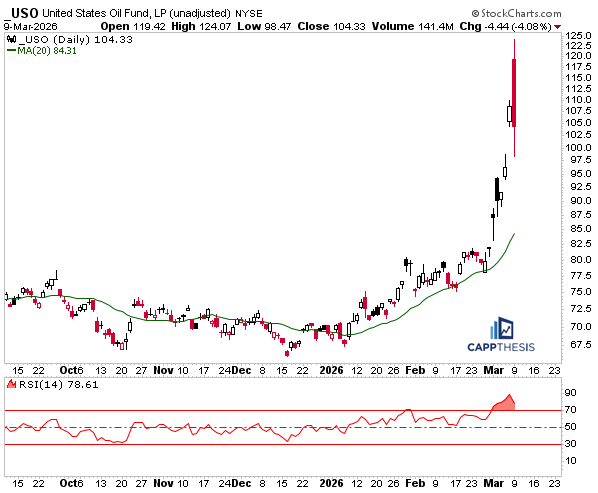
USO – Still extended
Regarding candlestick patterns, USO’s bearish engulfing pattern was enormous. As we know, this all started with Crude spiking nearly 20% on Sunday evening before reversing sharply lower – and whipping around the global financial landscape as a result.
Even though USO had already been strong since the start of 2026, trading above its 20-day moving average, the Middle East news clearly accelerated the move and pushed the ETF into a parabolic phase.
Whether the longer-term uptrend remains intact is still to be seen, but the pace of the initial spike tied to the war headlines was clearly unsustainable. From here, we’ll watch—similar to what we saw with gold and silver in recent months—how things settle down and whether any constructive bullish patterns begin to form.
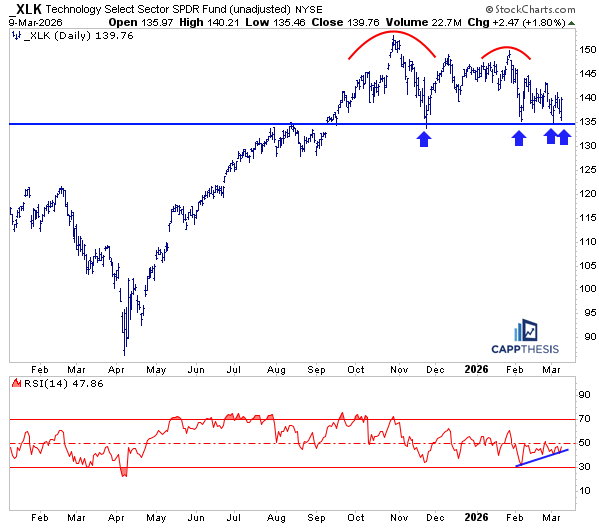
XLK – Respected very important support again
Not by coincidence, XLK’s big bounce commenced after falling close to the very important 135 support zone.
It’s clear that 135 has now held three times in 2026, and prior to that the level was also respected in November and September. With all of that price action helping construct a large potential topping formation, it is clearly imperative for that zone to continue to hold.
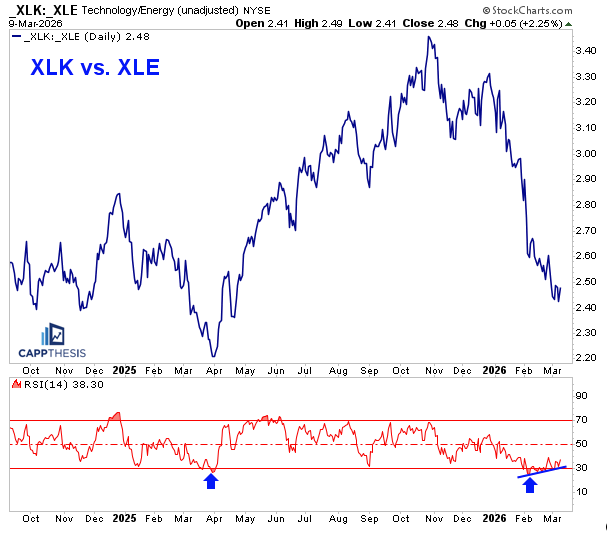
XLK vs. XLE – A start
With XLK rallying and XLE rolling over, the XLK vs. XLE relative line enjoyed a strong bounce. Here’s a chart we showed last week noting that the ratio had dropped to oversold and then was starting to flash a positive momentum divergence. Needless to say, this could be an opportune moment to see that setup begin to play out from here.
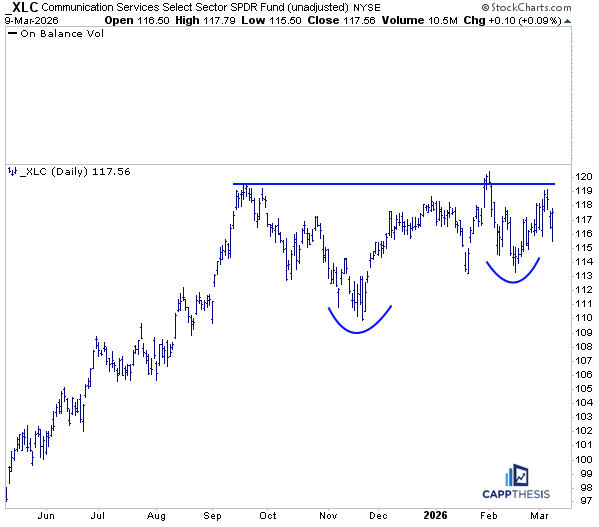
XLC – A potential bullish set up
The XLC communications ETF has yet to resemble the topping patterns that have been evident in many other technology and growth ETFs. From this daily perspective, we can see that higher lows have continued to form over the last few months. As a result, this structure could also be viewed as a potential bullish pattern.
Given how many big growth ETFs have failed near key resistance in recent months, actually seeing XLC overtake its own recent highs would be telling.
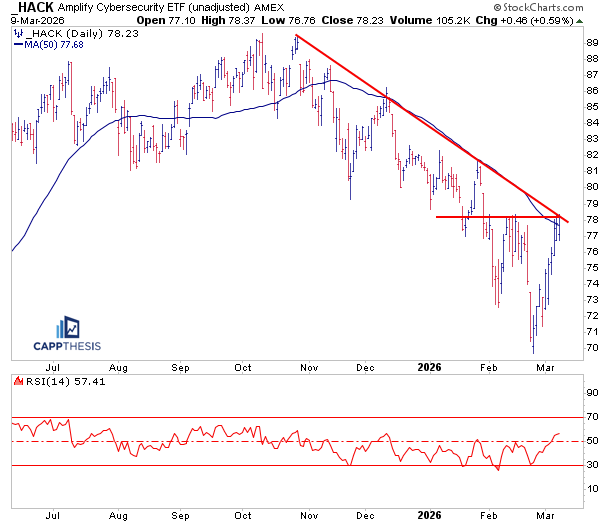
HACK – Up 9/10 days and staring at key resistance
Several areas have spiked over the last week and a half. Software is one example, but a better illustration may be the HACK ETF, which had also been trending lower for months.
As we can see, it has staged a very strong move since late February and now suddenly is up 9/10 trading days, which has quietly brought it back to resistance near 78. That level also coincides with the 50-day moving average and a downtrend line from the October 2025 highs.
In other words, as we’ve seen with previous bounces during the last few months, selling into strength has been routine. Seeing that happen again, thus, wouldn’t be a surprise. It’s what comes after the next round of profit taking is what truly matters. Case in point – it’s not hard to see how a potential higher low could turn the last few weeks into one large bullish formation.
GOOGL – Update
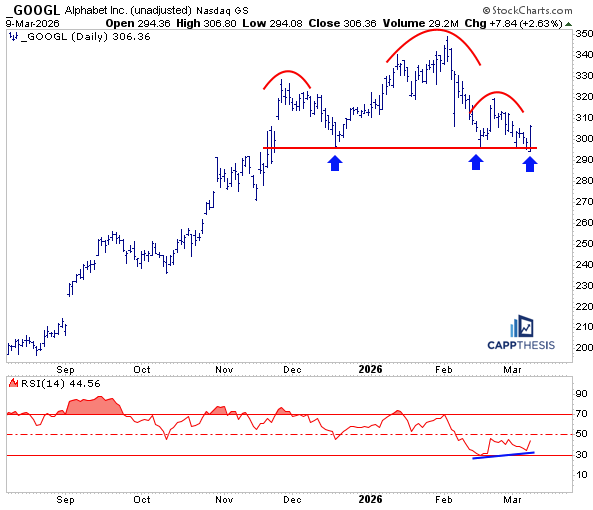
We mentioned yesterday how we were still waiting for some of the March Chart Trades to get moving. Google obviously did so in a major way yesterday. So far, it is once again tiptoeing around the neckline of a very clear bearish formation. But, it has not broken down, and there is still a positive momentum divergence in place...
GOOGL – New risk level
So, readjusting the chart here, any additional strength from this point would trigger the chart trade. We’ll use the 287 low as the stop, which is about 6% below last night’s close. We’ll keep the stop tight, given that volatility likely isn’t going away anytime soon. The upside target remains 349.

TSLA – Bounced where it needed to
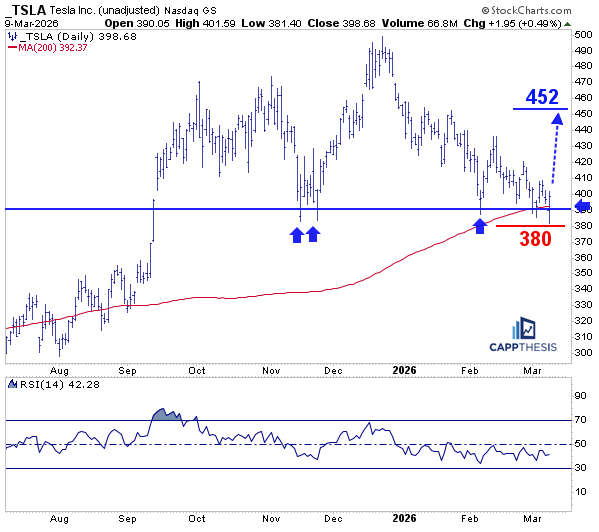
TSLA also finished off its lows after undercutting its key neckline on Monday. This, too, could see some upside follow-through.
For this one, we’ve moved the target down to 452, which represents the 61.8% retracement of the December-to-March decline. The stock is simply more volatile overall, so the idea would be to capture a bounce toward that level while managing risk near yesterday’s low, around 380.
TXN – Reversing near its 200-DMA
If communication services and consumer discretionary stocks are going to bounce, then we would likely expect the technology sector to move in unison. Of course, there’s no guarantee any of these will do more than what they did yesterday.
But if this does turn into a more substantial up move, there are plenty of stocks that have been hit hard enough for a rubber-band type bounce. We saw that in a very clear way with semiconductors yesterday.
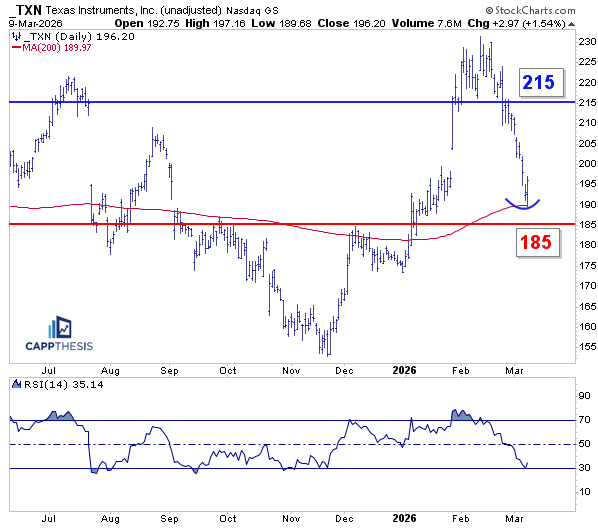
TXN caught our eye because it reversed near its 200-day moving average and is still logging higher lows since November. It also grazed oversold territory for the first time since November, and all of this happened within a few points of its breakout zone from earlier this year.
The 61.8% retracement level comes in around 215, which would serve as the upside target. Risk will be kept relatively tight, using the 185 area as a stop, just below the 200-day moving average and right near that January breakout zone.
CappNotes offers a small window into the work we do at CappThesis - a technical analysis newsletter company focused on classical chart patterns, trend, and risk management. Explore the full range of CappThesis services here: