

Summary
🔴 Stocks tumbled Thursday as a one-two combination of AI capex sticker shock and a fresh oil spike sent the tape to its worst session in a month.
Alphabet (GOOGL) and Tesla (TSLA), both reporting Wednesday night, set the tone: Alphabet’s results were strong but its ballooning capex guide spooked investors, while Tesla posted a clean profit miss.
The hyperscaler group sold off in sympathy as the market openly questioned whether AI infrastructure spending is starting to outrun returns.
Layered on top, Brent crude broke back above $100 a barrel for the first time since May after Houthi forces struck two Saudi tankers in the Red Sea, reviving inflation fears just as Treasury yields hit fresh highs for the year.
After the bell, Intel (INTC) delivered a blowout quarter that briefly lifted the mood in AI/semis, while Newmont (NEM) and MaxLinear (MXL) also posted beats.
Major Indices & Breadth
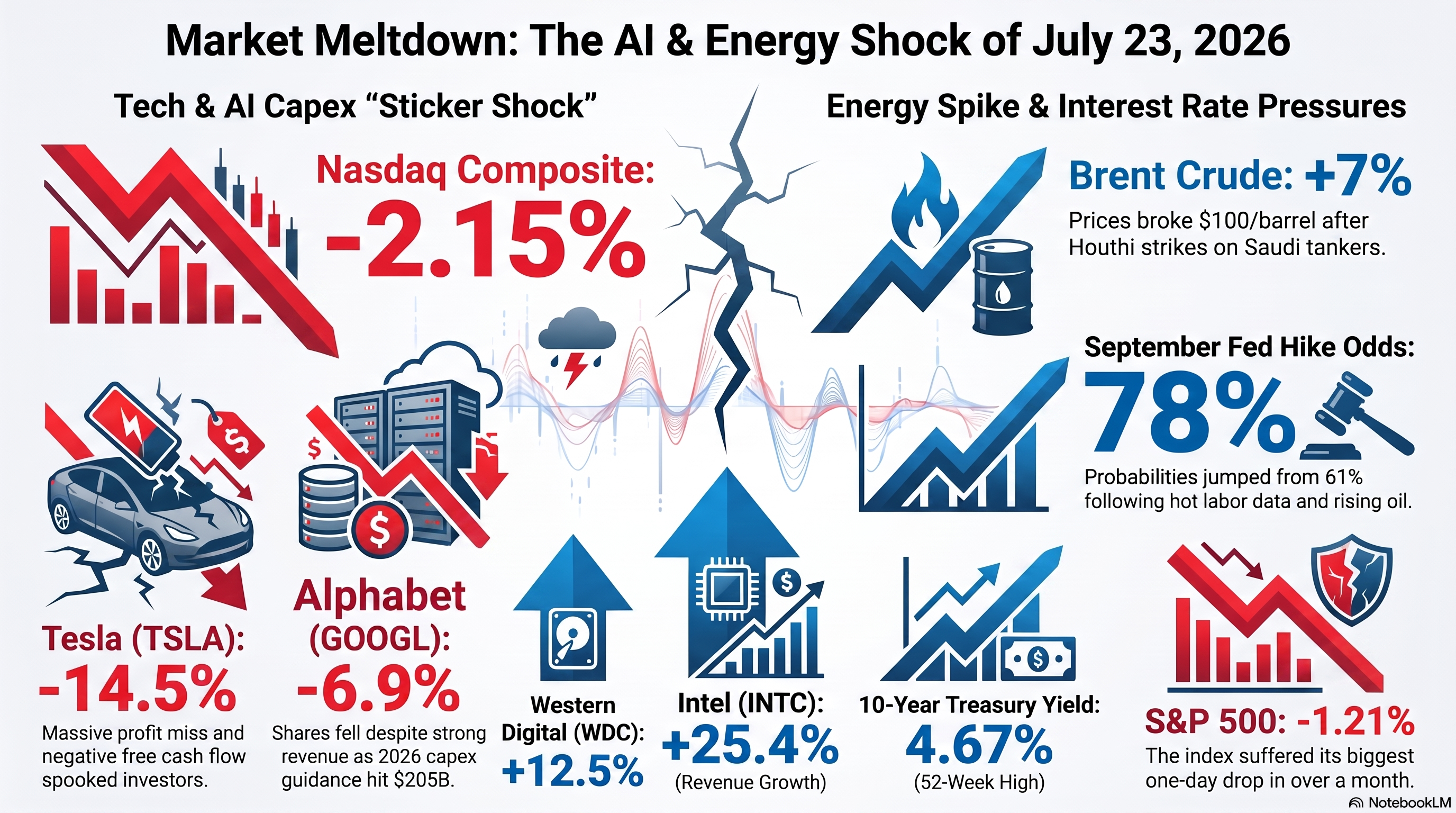
🔴 S&P 500 closed at 7,408.30, -1.21% (-90.66 points)—its biggest one-day drop in a month.
🔴 Nasdaq Composite fell -2.15% to 25,137.69, dragged lower by a 7% drop in GOOGL and heavy hyperscaler selling.
🔴 Dow Jones Industrial Average shed 506.93 points (-0.97%) to 51,711.65.
🔴 Russell 2000 fell roughly -0.9% to around 2,932—small-caps held up modestly better than the megacap-heavy indices.
🔴 Communication services and consumer cyclicals were the session’s weakest sectors.
🟢 Industrials and healthcare showed relative strength, helping cushion the broader decline.
🟢 Leaders
🟢 WDC +12.5%
🟢 RTX +7.4%
🟢 CVX +1.8%
🟢 MRK +1.3%
🟢 TRV +1.1%
🔴 Laggards
🔴 TSLA -14.5%
🔴 GOOGL -6.9%
🔴 AMZN -4.5%
🔴 META -3.2%
🔴 MSFT -2.1%
Earnings
🟢 INTC reported Q2 2026 after the close: revenue $16.13B, +25.4% YoY, crushing the $14.45B estimate; non-GAAP EPS $0.42 versus $0.21 expected. Data Center and AI revenue surged 59% YoY to $6.26B. Q3 guidance of $15.8B–$16.8B revenue came in above expectations, and 18A foundry yields were said to have climbed to roughly 85%. Shares jumped in after-hours trading toward the $110 area.
🟢 NEM posted Q2 adjusted EPS of $2.10, beating the $1.99 estimate, on revenue of $6.12B and net income of $2.2B. Shares dipped modestly in the immediate reaction despite the beat.
🔴 MXL reported Q2 revenue of $168.8M, +55% YoY and ahead of the $166.3M estimate, with non-GAAP EPS of $0.35 beating by $0.02. However, the company posted an operating loss of $4.2M, and shares fell roughly 4% after the print as investors focused on profitability over top-line growth.
🟢 GOOGL beat on both lines in Wednesday’s after-hours report—revenue +24% YoY to $119.08B, Google Cloud revenue +82% YoY—but shares fell 6.9% Thursday (see AI) after management raised 2026 capex guidance.
🔴 TSLA missed badly: EPS of roughly $0.33 versus a $0.54 estimate, even as revenue beat at $28.24B. Operating income fell more than 50% and free cash flow turned negative.
🟢 RTX Corporation (RTX) beat Q2 estimates on both lines and raised full-year adjusted EPS guidance to $7.10–$7.25 from $6.70–$6.90, citing a record $289B backlog (see Leaders).
AI
🔴 GOOGL’s capex guidance raise to roughly $195B–$205B for 2026—nearly double last year’s spend—was the day’s central AI story, reigniting debate over whether infrastructure outlays are outrunning near-term returns.
🟢 Google Cloud revenue growth of 82% YoY and 950 million monthly active Gemini app users argue the demand side is real, even if the market didn’t reward it Thursday.
🔴 Hyperscaler capex angst spread quickly: Microsoft (MSFT), Meta (META), Amazon (AMZN), and Oracle (ORCL) all fell in sympathy (see Laggards).
🔴 TSLA CEO Elon Musk called 2026 a “massive capex year” for the company on Wednesday’s call, citing Optimus robots, robotaxis, and data centers—part of why free cash flow went negative even as deliveries grew (see Earnings).
🟢 Western Digital (WDC) surged on renewed AI-memory demand and resumed Kioxia merger talks, with HDD production reportedly sold out through 2026 (see Leaders).
🟢 INTC’s 59% jump in Data Center and AI revenue was the clearest sign tonight that AI-driven compute demand remains intact even as the market questions hyperscaler spending discipline (see Earnings).
Corporate
🟡 A federal judge extended the suspension of Paramount Skydance’s $110B acquisition of Warner Bros. Discovery (WBD) until August 17, giving Paramount more time to fight opposition from a state coalition and the Writers Guild of America.
🟢 PG&E (PCG) beat on core EPS, with its data-center pipeline expanding 150% to 12.71 gigawatts.
🔴 PCG shares slipped as investors focused on how little of that pipeline is under firm agreements so far.
🟢 WDC’s resumed merger talks with Kioxia added to the day’s memory-sector momentum (see AI).
Market Structure
🟡 No major S&P 500, Dow, or Nasdaq-100 index rebalance actions or listing-rule changes were reported today.
🟡 In South Korea, the Korea Securities Depository confirmed the initial quota for converting SK Hynix local shares into U.S. ADRs has been fully exhausted, with two-way conversion applications set to open July 29.
Macro/Policy
🔴 Initial jobless claims for the week ending July 18 fell to 187K, sharply below both the 212K forecast and the revised 209K prior reading—resilient labor data that reinforced the case against near-term rate cuts.
🔴 The 10-year Treasury yield climbed to roughly 4.67%, a fresh 52-week high, as surging oil prices raised the odds the Fed will need to stay restrictive for longer (see Treasury Bonds).
🔴 Market-based pricing now shows better than a 33% chance of a hike at next week’s July 28–29 FOMC meeting, and the probability of a September hike has jumped above 78%, up sharply from 61% a day earlier (see Prediction Markets).
Treasury Bonds
🔴 10-year yield: ~4.67%, a fresh 52-week high, up modestly on the day.
🔴 2-year yield: ~4.30%, little changed but still elevated.
🔴 30-year yield: ~5.15%, tracking the broader move higher across the curve.
🟡 2s10s spread: roughly +0.37 percentage points, still comfortably positive but narrowing slightly as short-end yields firm.
Geopolitics
🔴 Yemen’s Houthi militants, backed by Iran, claimed missile and drone strikes on two Saudi Arabian oil tankers in the Red Sea, opening a second potential chokepoint for global crude flows alongside the near-shuttered Strait of Hormuz.
🔴 President Trump warned the U.S. would inflict “major military punishment” on Iran and the Houthis for further tanker attacks; Iran warned of retaliation against U.S.-linked regional infrastructure and energy assets.
🔴 The escalation followed the collapse of the prior US–Iran ceasefire, with no near-term diplomatic resolution visible.
Foreign Markets
🔴 Euro STOXX 50 fell 1.7% to 6,210, and the STOXX Europe 600 dropped 1.3% to 638, as surging energy prices raised the risk of further ECB tightening even as the central bank held rates unchanged Thursday.
🔴 UniCredit fell despite a strong quarter, as its pursuit of Germany’s Commerzbank raised concerns about its share buyback capacity; BNP Paribas also declined despite beating profit estimates.
🟢 South Korea’s Kospi rallied roughly 3–4% earlier in the session, led by Samsung and SK Hynix on AI-infrastructure optimism, ahead of Wall Street’s tech-led reversal (see Market Structure).
🔴 Asian equity futures pointed lower heading into Friday as the region braced to react to Wall Street’s steep tech-led selloff after Asia’s own close.
Currencies
🟡 U.S. Dollar Index (DXY): roughly 101.0–101.1, essentially flat on net, though the dollar’s safe-haven bid was strong intraday on escalating Middle East tensions.
🔴 USD/JPY: hit a fresh 40-year high near 163.2, with Japan’s finance minister reiterating readiness to intervene if yen weakness becomes excessive.
🟡 EUR/USD: traded lower after the ECB held rates unchanged and signaled inflation risks could warrant further tightening.
🟡 GBP/USD: little changed on the day.
Commodities
🟢 Brent crude: settled at $100.69/bbl, +7%, crossing $100 for the first time since May 26 (see Geopolitics).
🟢 WTI crude: settled at $92.19/bbl, +6%, its fifth straight daily gain.
🔴 Gold: fell to roughly $4,048.76/oz, -2.4%, as rising yields and a firmer dollar outweighed safe-haven demand from the Middle East escalation.
🔴 Silver traded lower alongside gold, changing hands in the high-$50s per ounce.
Crypto
🔴 Bitcoin (BTC) fell to roughly $64,936, -1.7%, tracking the broader risk-off tone in equities.
🔴 Crypto showed little sign of a safe-haven bid despite the geopolitical escalation, moving in step with the Nasdaq’s tech-led selloff instead.
Prediction Markets
🔴 Market-implied odds of a Fed rate hike at next week’s July 28–29 FOMC meeting rose above 33%, while the probability of a hike by the September meeting jumped above 78%, up from 61% just a day earlier (see Macro/Policy)—a sharp repricing driven by resilient jobless claims data and oil-driven inflation risk.
🟡 Broader 2026 rate-path contracts on platforms like Polymarket had been pricing meaningfully lower odds of any hike this year as recently as early July, underscoring how quickly the oil shock and hot data have shifted the market’s rate outlook in the past two weeks.
Volatility
🔴 VIX closed around 19.5, up roughly 17% from Wednesday’s 16.64 close—one of the sharper single-day vol jumps of the summer.
🔴 The move reflects the combined shock of AI-capex doubt and the Middle East-driven oil spike, with front-end vol likely to stay bid into Friday’s PMI data and next week’s FOMC meeting.
Tomorrow’s Calendar
Earnings before the open: American Express (AXP), Charter Communications (CHTR), Canadian National Railway (CNI), HCA Healthcare (HCA), NextEra Energy (NEE), Schlumberger (SLB), Verizon (VZ), and others.
S&P Global flash Manufacturing, Services, and Composite PMI for July at 9:45 AM ET.
New Home Sales for June at 10:00 AM ET.
Baker Hughes weekly rig count at 1:00 PM ET.
Geopolitical watch: any sign of de-escalation in the Red Sea or Strait of Hormuz could quickly reverse oil and vol; further attacks would compound the inflation/rate-hike narrative heading into next week’s FOMC.
3 Scenarios
🟢 Bullish: Friday’s PMI and new home sales data come in soft enough to ease rate-hike fears without alarming growth bulls; oil stabilizes below $100 Brent on any de-escalation signal; AI-capex jitters fade as investors refocus on Google Cloud’s 82% growth and Intel’s blowout quarter—indices stabilize and claw back part of Thursday’s loss.
🟡 Neutral: Oil holds near $100 Brent with no fresh escalation but no resolution either; PMI data comes in roughly in line; the market continues to digest the AI-capex debate stock by stock rather than resolving it—indices trade in a choppy, narrow range into next week’s FOMC.
🔴 Bearish: Houthi or Iranian attacks escalate further, pushing Brent decisively above $100 and reigniting the inflation scare; hot PMI data adds to hike odds; hyperscaler capex concerns spread to more AI-infrastructure names—the S&P 500 tests below 7,300 and the VIX pushes toward 25.
Final Take
Thursday’s selloff had two distinct engines, and they fed each other.
Investors are no longer taking AI infrastructure spending on faith—Alphabet’s near-doubling of its capex guide, even alongside genuinely strong cloud growth, was read as a warning sign rather than a vote of confidence, and the rest of the hyperscaler complex paid the price alongside it.
At the same time, the Middle East conflict found a new front, with Brent’s break above $100 a barrel doing real damage to the rate outlook just as labor data came in too strong for comfort.
That combination pushed September hike odds above 78% in a single session—a repricing that matters as much as the S&P’s 1.2% drop itself.
Intel’s blowout quarter after the bell is a reminder that the underlying AI compute story isn’t broken, even if the market’s patience with how much hyperscalers are willing to spend to chase it clearly is.
Friday’s PMI prints and next week’s FOMC meeting will go a long way toward determining whether this was a one-day repricing or the start of something more durable.
Source: CNBC, Reuters, Yahoo Finance, Bloomberg, Trading Economics, Washington Post, MarketScreener.
CappNotes offers a small window into the work we do at CappThesis - a technical analysis newsletter company focused on classical chart patterns, trend, and risk management. Explore the full range of CappThesis services here: