

🟢 Stocks drifted to a mixed, low-drama close Monday as the U.S. and Iran extended a pause in hostilities over the weekend, sending oil prices sharply lower and lifting travel and small-cap names.
The relief didn’t reach the AI trade, where Nvidia (NVDA) sank on a Wall Street Journal report that it’s discussing roughly $250 billion in financial guarantees to back OpenAI’s planned Ohio data center campus, reviving “circular financing” worries across the chip complex.
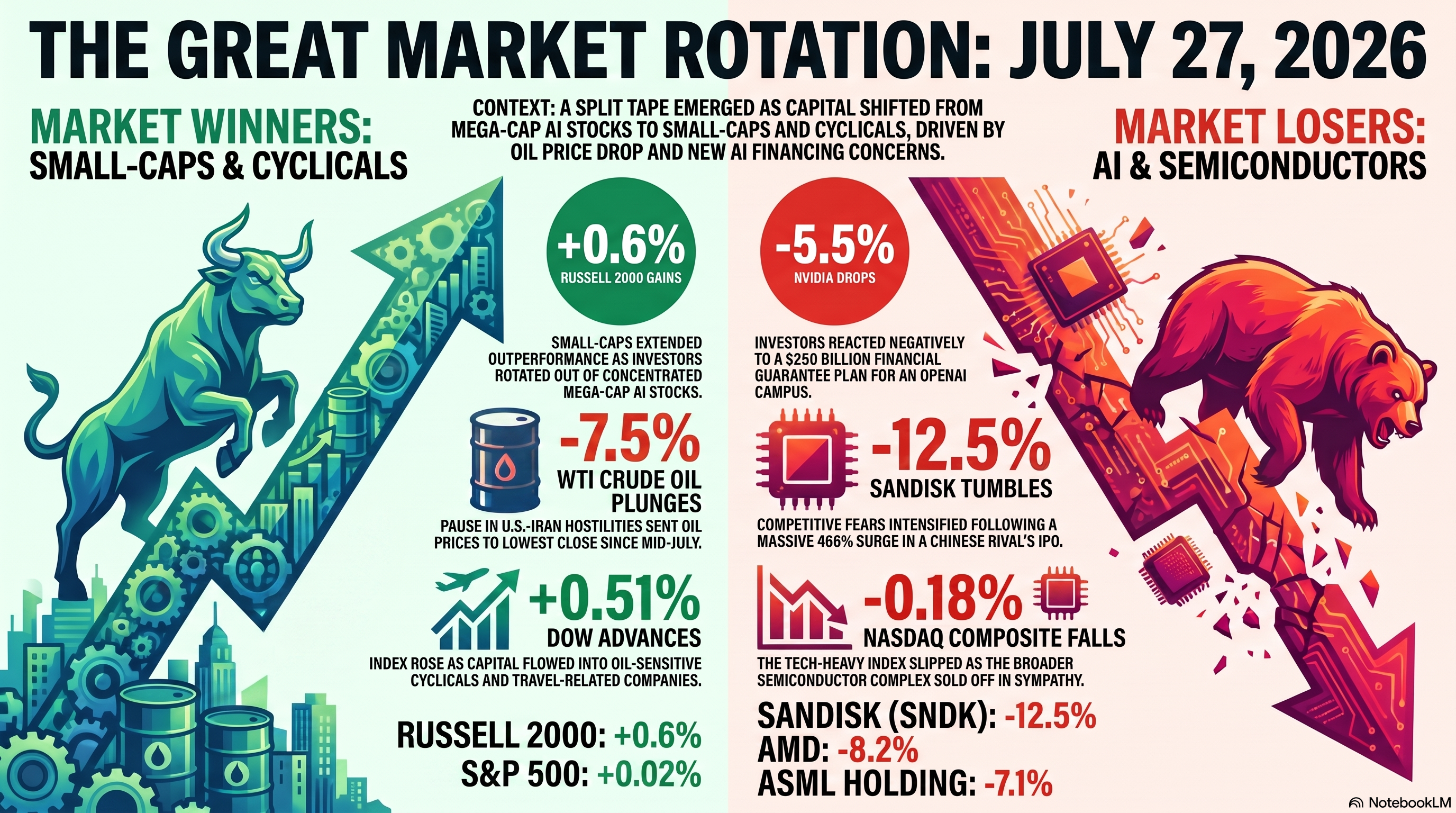
The Dow and Russell 2000 both advanced while the S&P 500 was flat and the Nasdaq slipped, a split that reflected capital rotating out of AI infrastructure names and into oil-sensitive cyclicals.
Markets are bracing for the busiest week of the quarter: the Fed’s two-day meeting begins Tuesday, and Microsoft (MSFT), Meta Platforms (META), Apple (AAPL), and Amazon (AMZN) all report earnings within a 48-hour window.
Major Indices & Breadth
🟢 Russell 2000 rose 0.6% to 2,948.03, a 18.04-point gain, as small-caps extended their outperformance over the AI-heavy Nasdaq
🟢 Dow Jones Industrial Average gained 0.51% (+262.83 points) to close at 52,210.08
🟡 S&P 500 edged up just 0.02% (+1.20 points) to 7,413.18, essentially flat after two straight weekly losses
🔴 Nasdaq Composite fell 0.18% (-43.74 points) to 24,932.08, weighed down by a roughly 5% drop in NVDA
🟡 Breadth was mixed and rotational rather than broadly risk-off or risk-on: oil-sensitive travel and small-cap cyclicals caught a bid while AI-infrastructure and memory-chip names sold off hard
🟢 The Russell 2000 continues to run well ahead of the Nasdaq in 2026 — up roughly 18.8% year-to-date versus the Nasdaq’s 7.3% — as investors broaden out beyond concentrated mega-cap AI exposure
🟢 Leaders
SAP +7.4%
NCLH +2.8%
CCL +2.1%
RCL +1.4%
🔴 Laggards
SNDK -12.5%
AMD -8.2%
ASML -7.1%
MU -5.7%
NVDA -5.5%
Earnings
🟡 Second-quarter earnings season remains unusually strong: as of Friday, 86% of S&P 500 companies that had reported topped EPS estimates and 80% beat on revenue, with blended earnings growth tracking 37.9% year-over-year, according to FactSet — the fastest pace since Q3 2021
🟢 SAP SE (SAP) extended last week’s post-earnings pop, adding to Friday’s beat-driven gains as the software maker’s backlog growth continued to draw buyers
🟡 No marquee large-cap prints crossed the tape Monday; the real test starts Tuesday and runs through Thursday as Big Tech and a wide swath of industrials report (see Tomorrow’s Calendar)
AI
🔴 NVDA closed down roughly 5.5%, its worst session since February, after the Wall Street Journal reported the company is in talks to guarantee up to $250 billion in financing to help OpenAI lease and build a 10-gigawatt Ohio data center campus — a structure investors worry ties Nvidia’s balance sheet to the demand of its own customers
🔴 The move compounds Friday’s news that NVDA agreed to a $500 billion AI-infrastructure partnership with South Korea’s SK Group and a $5 billion equity investment in Safe Superintelligence, adding to “circular financing” concerns Michael Burry and others have raised
🔴 Advanced Micro Devices (AMD) fell 8.2%, Micron Technology (MU) dropped 5.7%, and ASML Holding (ASML) lost 7.1% as the broader semiconductor complex sold off in sympathy
🔴 SanDisk (SNDK) tumbled 12.5% on competitive fears after a Chinese rival’s IPO (see Corporate)
🔴 The VanEck Semiconductor ETF (SMH) extended losses for a second session as chip names gave back some of last week’s gains
🟡 DeepSeek reportedly suspended a $74 billion funding round after its founder’s leaked comments, an added wrinkle in the AI-financing narrative
🟡 The market’s next AI catalysts land mid-week: MSFT and META report Wednesday, AMZN and AAPL Thursday (see Tomorrow’s Calendar)
Corporate
🟢 Chinese memory-chip maker ChangXin Memory Technologies (CXMT) surged 466% in its Shanghai IPO debut, an $8.6 billion listing that intensified oversupply fears for U.S. memory names and helped drive SNDK’s slide
🔴 Tesla (TSLA) and SpaceX (SPCX) have together shed a combined $1.2 trillion in market value in July, one of the sharpest monthly drawdowns for the pair on record
🟡 Yum Brands’ (YUM) Taco Bell chain is absorbing the bulk of online chatter tied to a cyclospora outbreak, according to Wolfe Research social-listening data, with peers Chipotle Mexican Grill (CMG), Sweetgreen (SG), and Cava Group (CAVA) largely avoiding the spotlight
🟡 Four carriers — Delta Air Lines (DAL), United Airlines (UAL), American Airlines (AAL), and Southwest Airlines (LUV) — control roughly 73% of domestic passenger traffic; analysts expect 15–20% fare hikes to persist through year-end even as fuel costs retreat, since none has an incentive to cut prices first
Market Structure
🟡 No index rebalances, additions/removals, or trading-mechanics changes (listing rules, circuit-breaker thresholds, trading-hours changes) took effect today; the next scheduled S&P 500/Nasdaq-100 quarterly rebalance isn’t until the September third Friday
Macro / Policy
🟡 The Fed’s two-day policy meeting begins Tuesday, with Chair Kevin Warsh facing a genuinely live decision for the first time this cycle; markets currently price roughly a 30% chance of a hike at Wednesday’s announcement and about an 80% probability of one by September (see Prediction Markets)
🟡 Fed funds futures have moved meaningfully in the past week as oil prices whipsawed; a weak-jobs-driven dovish repricing earlier in July has partly reversed on renewed energy-driven inflation fears, even as today’s oil plunge eased some of that pressure
🟡 Second-quarter GDP (advance) and June PCE inflation, the Fed’s preferred gauge, are both due Thursday alongside Big Tech earnings — a potentially volatile combination
Treasury Bonds
🟢 10-Year Treasury yield fell 4 basis points to 4.639%, pulling back from six-month highs
🟢 2-Year Treasury yield dropped roughly 3 basis points to 4.303%
🟢 30-Year Treasury yield eased about 3 basis points to 5.127%
🟡 The 2s10s spread held around 34 basis points, little changed, as the curve moved lower in a roughly parallel shift
Geopolitics
🟡 The U.S. and Iran held fire for a third consecutive night after Washington suspended its nearly two-week bombing campaign late Friday and Tehran said it ended retaliatory strikes; both sides have reportedly opened talks with Oman on reopening the Strait of Hormuz
🟡 The pause remains fragile: Yemen’s Houthis claimed fresh attacks on Saudi Aramco-linked facilities in Jizan and Yanbu over the weekend, though neither Saudi Arabia nor Aramco has confirmed the strikes
🟡 Flows through the Strait of Hormuz remain around 15% of pre-war levels against a normal run-rate of roughly 20 million barrels a day, according to market analysts — a reminder that a diplomatic pause hasn’t yet restored actual supply
🟡 Kazakhstan has more than halved its daily oil output after drone attacks disrupted the Caspian Pipeline Consortium’s Black Sea export terminal, though loadings reportedly resumed Monday
Foreign Markets
🟢 European equities rose broadly on the same Iran relief trade, with London’s FTSE 100 up 0.32% and the FTSE 250 gaining 0.63%
🟡 Asian markets were mixed overnight as investors weighed the oil-driven relief against ongoing AI-valuation jitters carried over from Friday’s chip selloff
Currencies
🔴 U.S. Dollar Index (DXY) fell 0.28% to 101.18, giving back some of last week’s gains as oil-driven inflation bets cooled
🔴 EUR/USD rose 0.27% to 1.1397 as the euro rebounded from last week’s one-year lows
🔴 USD/JPY slipped 0.13% to 163.57, a modestly weaker dollar against the yen despite persistent intervention chatter from Japanese officials
🟢 GBP/USD eased 0.13% to 1.3291, pulling back near its weakest level since July 1 ahead of Thursday’s Bank of England decision
Commodities
🔴 WTI crude fell 7.5% to settle at $82.61 a barrel, its lowest close since mid-July
🔴 Brent crude dropped 8.7% to settle at $88.36 a barrel, giving back last week’s push above $100 (see Geopolitics)
🟢 Gold rose 0.62% to $4,077.21 an ounce as softer yields and a weaker dollar offset the fading war premium
🟢 Silver climbed 0.95% to $58.53 an ounce, tracking gold higher
Crypto
🟢 Bitcoin (BTC) held above $65,000, extending a fourth straight weekly gain as easing geopolitical tensions supported risk appetite broadly
🟡 Spot Bitcoin ETFs posted inflows for a third consecutive week, a mild signal of improving institutional demand ahead of Wednesday’s Fed decision
Prediction Markets
🟡 CME FedWatch and Polymarket odds continue to point to a Fed hold this week, with a hike far more likely by the September meeting (see Macro/Policy)
🟡 Prediction markets on Polymarket are already pricing Tuesday’s earnings from PayPal (PYPL), Boeing (BA), and Visa (V), with traders leaning toward beats across all three ahead of tomorrow’s prints (see Tomorrow’s Calendar)
Volatility
🟡 VIX rose to around 19.4, up from Friday’s 18.58 close but still holding below the 20 level associated with elevated investor concern
🟡 The muted volatility response to a sharp single-stock NVDA decline suggests today’s selling was rotational rather than a broad de-risking event
Tomorrow’s Calendar
S&P/Case-Shiller Home Price Index (9:00 AM ET) — May
CB Consumer Confidence (10:00 AM ET) — July
JOLTs Job Openings (10:00 AM ET) — June
Richmond Fed Manufacturing Index (10:00 AM ET) — July
FOMC two-day meeting begins
BA, United Parcel Service (UPS), Coca-Cola (KO), PYPL, Royal Caribbean (RCL), JetBlue Airways (JBLU) — earnings before the open
V, KLA Corporation (KLAC), Ford Motor (F), Enphase Energy (ENPH), Seagate Technology (STX) — earnings after the close
3 Scenarios
🟢 Bullish: The Iran pause holds through the week, oil stays soft, and the Fed’s Wednesday statement leans dovish enough to keep September hike odds in check. MSFT and META reassure on AI capex returns Wednesday night, and the Russell 2000’s leadership broadens into mega-cap tech, pushing the S&P 500 toward fresh highs.
🟡 Neutral: The Fed holds as expected but keeps a live hike on the table for September, and Wednesday’s Big Tech earnings deliver a mixed verdict on AI spending, similar to Alphabet’s mixed reaction last week. Indices grind sideways in a narrow range while the small-cap/mega-cap rotation continues under the surface.
🔴 Bearish: Renewed Iran-Houthi escalation reopens the energy-inflation channel just as the Fed signals a live hike, and Wednesday-Thursday’s earnings from MSFT, META, AAPL, and AMZN reinforce fears that AI capex is outrunning returns. NVDA’s financing overhang deepens, dragging the broader chip complex toward a deeper correction.
Final Take
Monday’s tape looked calm on the surface — a flat S&P 500, a modest Dow gain — but that stillness masked a real rotation underneath.
Oil’s sharp retreat on the Iran pause is a genuine tailwind for travel, small-caps, and the inflation outlook heading into Wednesday’s Fed decision.
At the same time, the AI trade took its own hit, not from a demand scare but from a financing-structure scare: NVDA guaranteeing hundreds of billions in OpenAI’s data-center debt is a different kind of risk than a disappointing chip order, and the market is still working out how to price it.
With MSFT, META, AAPL, and AMZN all reporting within 48 hours and the Fed meeting concluding Wednesday, this week will do more to settle the AI-capex and rate-path questions than the last month combined.
Bottom line: today’s split tape — cyclicals up, AI infrastructure down — is a preview of the tension the market has to resolve this week, not a resolution of it.
Source: AP, CNBC, Reuters, Bloomberg, Yahoo Finance, Trading Economics, TipRanks, TradingKey.
CappNotes offers a small window into the work we do at CappThesis - a technical analysis newsletter company focused on classical chart patterns, trend, and risk management. Explore the full range of CappThesis services here: