


Summary
Stocks closed out a wild July on a high note Friday, with a blockbuster cloud-earnings beat from one hyperscaler (AMZN) overpowering a disappointing guidance-driven slide from another.
The broader tape rallied as the AI trade got a fresh vote of confidence, even as bond yields pushed to multi-year highs and simmering Middle East tensions kept oil elevated into the weekend.
Beneath the index-level calm, single-stock volatility was extreme — several earnings reactions were the worst in company history — a reminder that this market is rewarding execution and punishing anything short of it.
Japan’s currency-intervention drama and a hawkish drumbeat from Fed officials added extra texture to a session that closed the book on a choppy month.
Major Indices & Breadth
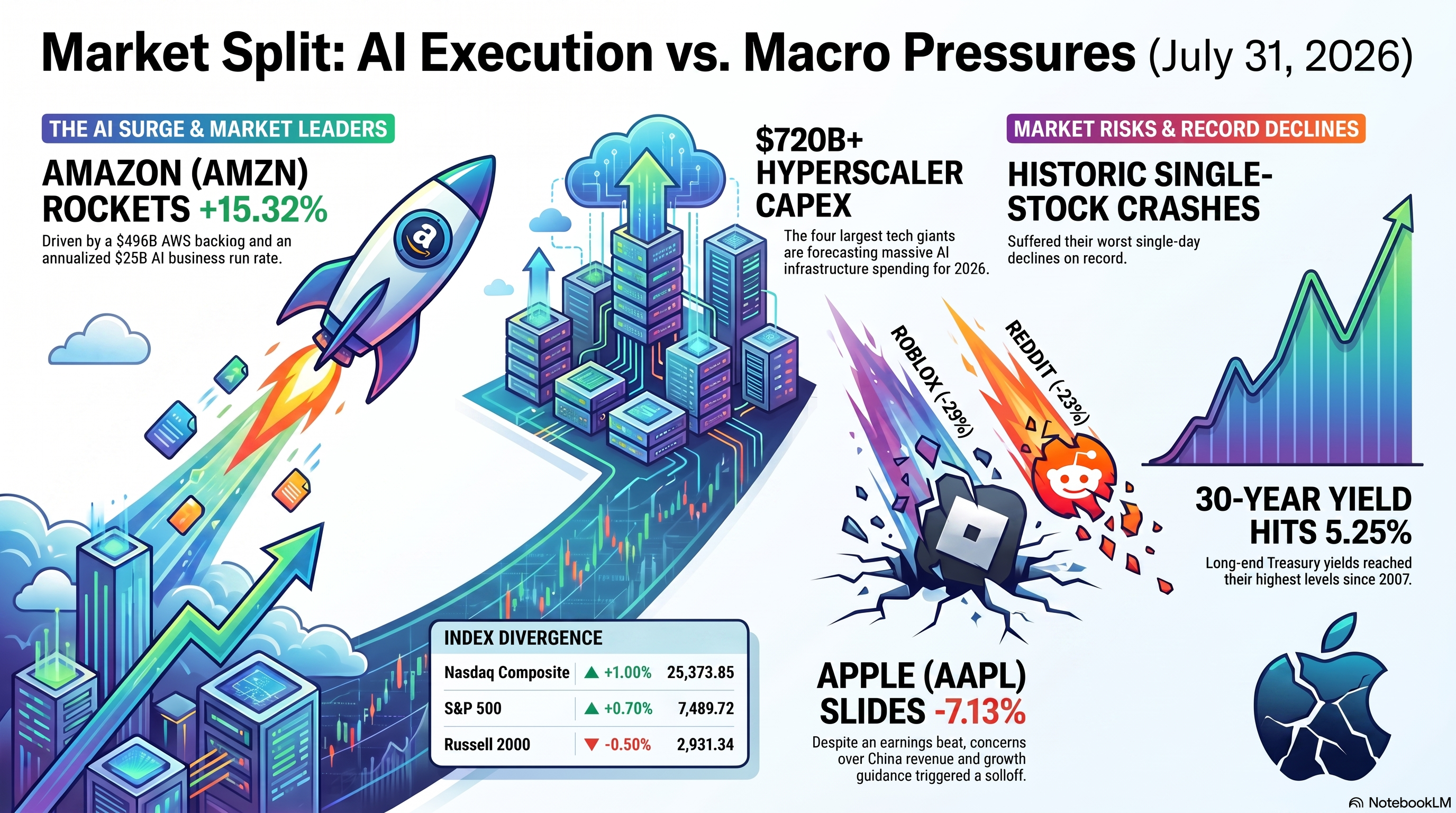
🟢 Nasdaq Composite rose +1.00% to 25,373.85 — led the tape on hyperscaler cloud strength.
🟢 S&P 500 gained +0.70% to 7,489.72.
🟢 Dow Jones Industrial Average added +0.53% (+276.97 points) to 52,485.03 — its fourth straight monthly gain.
🔴 Russell 2000 lagged, down -0.50% to 2,931.34, as small-caps didn’t participate in the mega-cap-driven rally.
🟢 For the week, the Dow and S&P 500 each rose roughly +1%, while the Nasdaq advanced about +1.6%.
🟡 For July, the S&P 500 slipped -0.1% and the Nasdaq fell -3.2% — its worst month in over a year — while the Dow bucked the trend with a +0.3% monthly gain.
🟢 Leaders
AMZN +15.32%
FERG +8%
GOOGL +7.12%
NVDA +3.46%
META +3.3%
FSLR +3.1%
MSFT +3%
RIVN +2%
CVX +1.71%
🔴 Laggards
KPTI -60%
RBLX -29%
RDDT -23%
COIN -8.03%
AAPL -7.13%
NFLX -2%
BA -1.90%
UNH -1.58%
XOM -1%
Earnings
🟢 Amazon (AMZN) delivered the quarter the AI trade needed: Q2 revenue of $200.6B (+20% YoY) beat the $196.5B estimate, AWS revenue jumped +36.7% YoY to $42.2B — its fastest growth since 2021 and well ahead of the $40.5B estimate — and operating income surged +43% to $27.5B. The AWS backlog stands at $496B, and management said its AI and custom-chip businesses have each crossed a $25B annualized run rate. Capex guidance for 2026 was raised to $220B from $200B. AMZN shares rocketed +15.32% to close at $271.58 — its biggest one-day move since 2012.
🟢 First Solar (FSLR) topped Wall Street’s second-quarter profit estimates even as revenue came in roughly in line. FSLR shares rose +3.1%.
🟢 Rivian (RIVN) posted an adjusted loss of $0.47/share, narrower than the $0.63 estimate, on revenue of $1.658B that beat the $1.507B consensus. The EV maker also raised its full-year delivery guidance to 65,000-70,000 vehicles from 62,000-67,000 and trimmed its 2026 spending plans. RIVN shares rose +2%.
🟢 Chevron (CVX) posted adjusted EPS of $6.06, well above the $5.55-$5.56 estimate, on revenue of $70.06B versus $62.26B expected — its highest adjusted profit in over five years, helped by record U.S. production and higher oil prices. CVX shares gained +1.71%.
🔴 ExxonMobil (XOM) also beat on profit as higher oil prices and global supply disruptions boosted results, but limited refinery capacity kept the company from fully capturing the upside. XOM shares fell -1%.
🔴 Apple (AAPL) beat on both lines — fiscal Q3 revenue of $109.42B (+16.4% YoY) versus a $108.65B estimate, and EPS of $2.02 — powered by +22% iPhone growth. But Services revenue of $30.74B missed the $31.22B estimate, Greater China revenue of $18.8B missed the $19.5B estimate, and guidance pointed to just 9-11% revenue growth next quarter on supply constraints, versus analysts’ 12%+ expectation. AAPL shares fell -7.13% — the stock’s worst decline in 16 months.
🔴 Coinbase (COIN) posted a third straight quarterly loss, with net loss of $359.4M far wider than the roughly $0.23/share expected, as total transaction revenue fell -21% to $599M on a prolonged crypto-trading slowdown. COIN shares dropped -8.03%.
🔴 Reddit (RDDT) beat estimates on both lines — EPS of $1.25 versus $0.95 expected, and revenue of $805M (+38.2% YoY) versus $730.4M expected — but shares still cratered after the company failed to announce any new data-licensing agreements on the earnings call. RDDT shares plunged -23%, their worst single-day decline on record.
🔴 Roblox (RBLX) beat on EPS but missed on bookings growth (just +8%) and withdrew its full-year 2026 guidance entirely; two Wall Street analysts issued Sell ratings, with one warning the platform may be entering “lifecycle decline.” RBLX shares collapsed -29%, their worst single-day loss on record.
🟡 Additional notable earnings: MicroStrategy (MSTR) posted an adjusted EPS loss of $424.45 versus a $3.07 loss expected, dominated by an $8.3B unrealized bitcoin markdown; Ameren (AEE) beat on EPS ($1.13 vs. $1.08 est.) but missed on revenue.
AI
🟢 AMZN‘s AWS beat and raised capex guide (see Earnings) gave the broader AI infrastructure trade a lift into the close: Alphabet (GOOGL) gained +7.12%, Nvidia (NVDA) rose +3.46%, Meta (META) added +3.3%, and Microsoft (MSFT) rose +3% — all riding the same read-through that hyperscaler AI spending is starting to show a payoff, not just a cost.
🟢 The four largest hyperscalers are now forecasting a combined $720-745B in 2026 capital spending, reinforcing that the AI buildout shows no signs of slowing even as investors demand proof of returns.
Corporate
🟡 RDDT is pressing forward with its copyright lawsuit against Perplexity over AI data scraping, even as the stock absorbed its worst trading day on record (see Earnings).
🟡 Senate Democrats Richard Blumenthal, Adam Schiff, and Elizabeth Warren sent letters to the Departments of Commerce, Defense, Energy, and Interior and the Export-Import Bank demanding they preserve records tied to more than a dozen critical-minerals deals — worth over $8.9B — that potentially benefit companies with financial ties to the Trump and Commerce Secretary Lutnick families.
Market Structure
🟢 Ferguson Enterprises (FERG) surged +8% after news broke the industrial supplier will be added to the S&P 500 — index inclusion typically triggers forced buying from passive funds tracking the benchmark, and traders moved ahead of the mechanical flows.
Macro/Policy
🟡 The Fed held rates steady at 3.50%-3.75% at Wednesday’s meeting under Chair Kevin Warsh, but the vote was unusually split, with three FOMC members dissenting in favor of an immediate hike. Friday brought a fresh round of hawkish commentary: Minneapolis Fed’s Kashkari said he’d prefer smaller hikes sooner rather than later, Cleveland Fed’s Hammack warned that delay makes inflation costlier to unwind, and Dallas Fed’s Logan said inflation risks skew to the upside — all reinforcing the case for a September move (see Prediction Markets).
🟡 The Bank of Japan held its policy rate at 1% in an 8-1 vote Friday, with board member Takata dissenting in favor of a hike to 1.25% (see Currencies for the yen’s intervention-driven volatility this week).
🟡 Reports surfaced that Fed officials are weighing proposals to reduce the frequency of policy meetings below the traditional eight per year — a structural change that would lower headline risk but complicate real-time policy communication.
Treasury Bonds
🔴 30-Year Treasury yield climbed to roughly 5.25%-5.28%, its highest level since 2007.
🔴 10-Year Treasury yield rose to about 4.74%, its highest since January 2025.
🔴 2-Year Treasury yield stood near 4.28%-4.29%.
🔴 The 2s10s spread widened to 0.47%, reflecting a steepening curve as long-end yields led the move higher on rising rate-hike odds and persistent inflation concerns (see Macro/Policy).
Geopolitics
🔴 The Strait of Hormuz remained a flashpoint: Iran claimed it attacked two tankers transiting the waterway under U.S. military escort, and reported four more turned back — though Western maritime authorities haven’t confirmed the incident, and ship-tracking data showed two large crude carriers still exited the Strait successfully.
🟡 Saudi Arabia held talks with representatives from 43 countries on forming a maritime coalition to protect Red Sea shipping routes following a Houthi blockade.
🔴 Renewed attacks near Russia’s Black Sea oil export infrastructure, including the CPC terminal critical to Kazakhstan’s crude shipments, added to global supply concerns (see Commodities).
Foreign Markets
🟢 South Korea’s Kospi surged roughly +20% — its largest single-day gain on record, surpassing the prior record of nearly +12% set in October 2008 — rebounding after a punishing three-day, 17%+ slide tied to AI-bubble fears earlier in the week.
🟢 Taiwan’s Taiex jumped +8%, powered by a +10% surge in Taiwan Semiconductor (TSM).
🟢 Japan’s Nikkei 225 rose +4% (+2,494 points) to 64,362, closing out the week on relief from strong hyperscaler earnings and the BOJ’s steady-rate decision.
🟢 Shanghai Composite edged up +0.7% to 3,832.
🟢 Hang Seng was roughly flat, +0.1%, to 25,884.
Currencies
🟢 DXY rose +0.33% to 100.19, as the dollar firmed broadly into the weekend.
🟢 EUR/USD fell -0.23% to 1.1501.
🔴 USD/JPY slipped -0.07% to 159.41, a muted net move that masks a wild week — the yen surged as much as 3.3% intraday Thursday on suspected Bank of Japan intervention, a move several multiples of its typical 0.3%-0.5% daily range, before paring most of the gain. The U.S. Treasury signaled Friday it may also intervene to support the yen, and Tokyo is estimated to have spent roughly $53B defending the currency Thursday alone.
🔴 GBP/USD rose +0.12% to 1.3324.
Commodities
🟢 WTI crude rose +1.29% to $84.67 — capping a monthly gain of over 20%, its strongest since March, on renewed Hormuz supply fears (see Geopolitics).
🟢 Brent crude gained +1.2% to $90.12, also up over 20% for the month.
🟢 Natural gas rose +1.16% to $2.79, though it remains near multi-month lows on ample supply.
🟢 Copper climbed +0.64% to $6.49/lb, on track for a roughly +4% monthly gain on steady industrial and AI-datacenter demand.
🔴 Gold fell -1.29% to $4,107, pressured by the firmer dollar and rising rate-hike odds.
🔴 Silver dropped -2.35% to $57.62.
Crypto
🔴 Bitcoin (BTC) fell about -3% to roughly $63,038, weighed down by rising rate-hike expectations, climbing bond yields, and the broader AI-stock selloff (see Laggards). Even so, BTC is on track to end July up roughly +7.5%, with analysts noting far less leveraged positioning heading into this week’s Fed meeting than earlier in the cycle, which has limited forced selling.
Prediction Markets
🔴 Kalshi traders now price a 59% chance of a 25-basis-point Fed rate hike in September, up from 54% earlier in the week, following Wednesday’s divided FOMC vote and Friday’s hawkish Fed commentary (see Macro/Policy). Polymarket pricing sits in a similar mid-60% range.
🔴 In crypto options, Friday’s $10B Bitcoin and ether expiry saw open interest shift bearish for August — the $60,000 put is now the most-watched strike, displacing the $70,000/$72,000 calls that dominated positioning heading into this week’s Fed decision.
Volatility
🟢 VIX fell -6.44% to 15.99, a notably calm index-level read given the day’s extreme single-stock dispersion — several individual earnings reactions (see Laggards) were the worst on record for those names, even as broad-market volatility stayed subdued.
Tomorrow’s Calendar
9:45 AM ET: S&P Global Manufacturing PMI, final (July)
10:00 AM ET: Construction Spending (June)
10:00 AM ET: ISM Manufacturing PMI (July)
Earnings before the open: Tyson Foods (TSN), Marriott (MAR), CNH Industrial (CNH)
Earnings after the close: Palantir Technologies (PLTR), ON Semiconductor (ON), Vertex Pharmaceuticals (VRTX), Snap (SNAP)
Week ahead: Tuesday brings JOLTS job openings and earnings from Caterpillar (CAT), Merck (MRK), McDonald’s (MCD), and Pfizer (PFE) before the open, and Advanced Micro Devices (AMD) and Amgen (AMGN) after the close. Wednesday brings ADP employment and ISM Services, plus earnings from Eli Lilly (LLY) and Walt Disney (DIS). The week’s headline event is Friday’s July nonfarm payrolls report.
3 Scenarios
🟢 Bullish: The AI trade broadens beyond AMZN as GOOGL, NVDA, and META extend Friday’s gains into next week; Monday’s ISM Manufacturing print stabilizes; hawkish Fed rhetoric proves overdone ahead of September. S&P 500 pushes toward 7,550+.
🟡 Neutral: Monday’s ISM print comes in mixed; Treasury yields hold near multi-year highs without a fresh breakout; earnings-driven single-stock dispersion (AMZN vs. AAPL, RDDT, RBLX, COIN) continues without a clear market-wide direction. S&P 500 chops between 7,400-7,500.
🔴 Bearish: Long-end Treasury yields (see Treasury Bonds) push further and start to weigh on equity valuations broadly; ISM disappoints; Kalshi’s September hike odds climb further past 59%; Hormuz tensions escalate anew. S&P 500 tests 7,300-7,350, and VIX moves back above 18-20.
Final Take
Friday told two stories at once. On the surface, a broad, calm rally — S&P 500 to a fresh closing high, VIX under 16 — capped a choppy July.
Underneath, this was one of the most violent single-stock earnings weeks in memory: AMZN‘s best day since 2012 sat right next to RBLX‘s and RDDT‘s worst days on record, with AAPL and COIN also getting punished despite beating estimates on several metrics. T
he common thread is that the market is no longer rewarding a beat — it’s demanding proof of durable growth (AWS’s accelerating backlog) or punishing anything that reads as decelerating (RBLX‘s bookings miss, AAPL‘s China and Services misses, RDDT‘s lack of new licensing deals).
Layer on top of that a bond market pricing in real odds of a September hike, multi-year highs on the 10- and 30-year, and a yen that moved several multiples of its normal daily range this week, and July ends with plenty of unresolved tension heading into August’s jobs report.
Bottom line: Monday’s ISM print and PLTR’s earnings are a warm-up — the real test is whether next week’s AI infrastructure earnings (AMD) and Friday’s payrolls report confirm the “quality over quantity” read the market delivered today.
Source: CNBC, Bloomberg, Reuters, TheStreet, Trading Economics, Yahoo Finance, CoinDesk, Investrade.
CappNotes offers a small window into the work we do at CappThesis - a technical analysis newsletter company focused on classical chart patterns, trend, and risk management. Explore the full range of CappThesis services here: